


New Rail Link Confirmed to Connect Palma Airport with City Centre and Llucmajor
Saturday, April 18th, 2026
The Balearic Government has formally approved the plans for a major new railway line connecting Palma to Llucmajor, with Palma Airport as a strategic hub. This decision marks the most significant expansion of Mallorca’s rail network in nearly two decades, establishing a high-capacity link that will serve both the local population and the millions of passengers who transit through the airport each year. With a total investment of €811 million, the line is projected to carry approximately 8.5 million passengers annually.
A Dedicated Airport Connection
A cornerstone of this infrastructure project is the integration of a dedicated rail station directly into the terminal at Palma Airport. While the exact location within the airport grounds will be finalised during the technical drafting phase, the government has confirmed that this link will drastically reduce transfer times for passengers. Unlike current bus services, which are subject to motorway traffic, the new rail link will offer a predictable transit option, with estimates suggesting a journey time of approximately 12 minutes between central Palma and the airport terminal.
The new line is designed to integrate seamlessly with Mallorca’s existing rail network at Son Costa – Son Fortesa. As an established transport hub, Son Costa already serves the T1, T2, and T3 train lines, as well as the M1 Metro. By connecting the airport line to this hub, the project ensures that air travellers can easily transfer to the rest of the island’s rail infrastructure.
For visitors aiming for the heart of the capital, Son Costa is located just 2.7 km from Plaça d’Espanya, the island’s primary transport interchange. From Son Costa, it is a mere 7-minute train journey to Plaça d’Espanya, providing a good option for tourists wishing to explore Palma’s historic Old Town immediately upon arrival.
Proposed Route
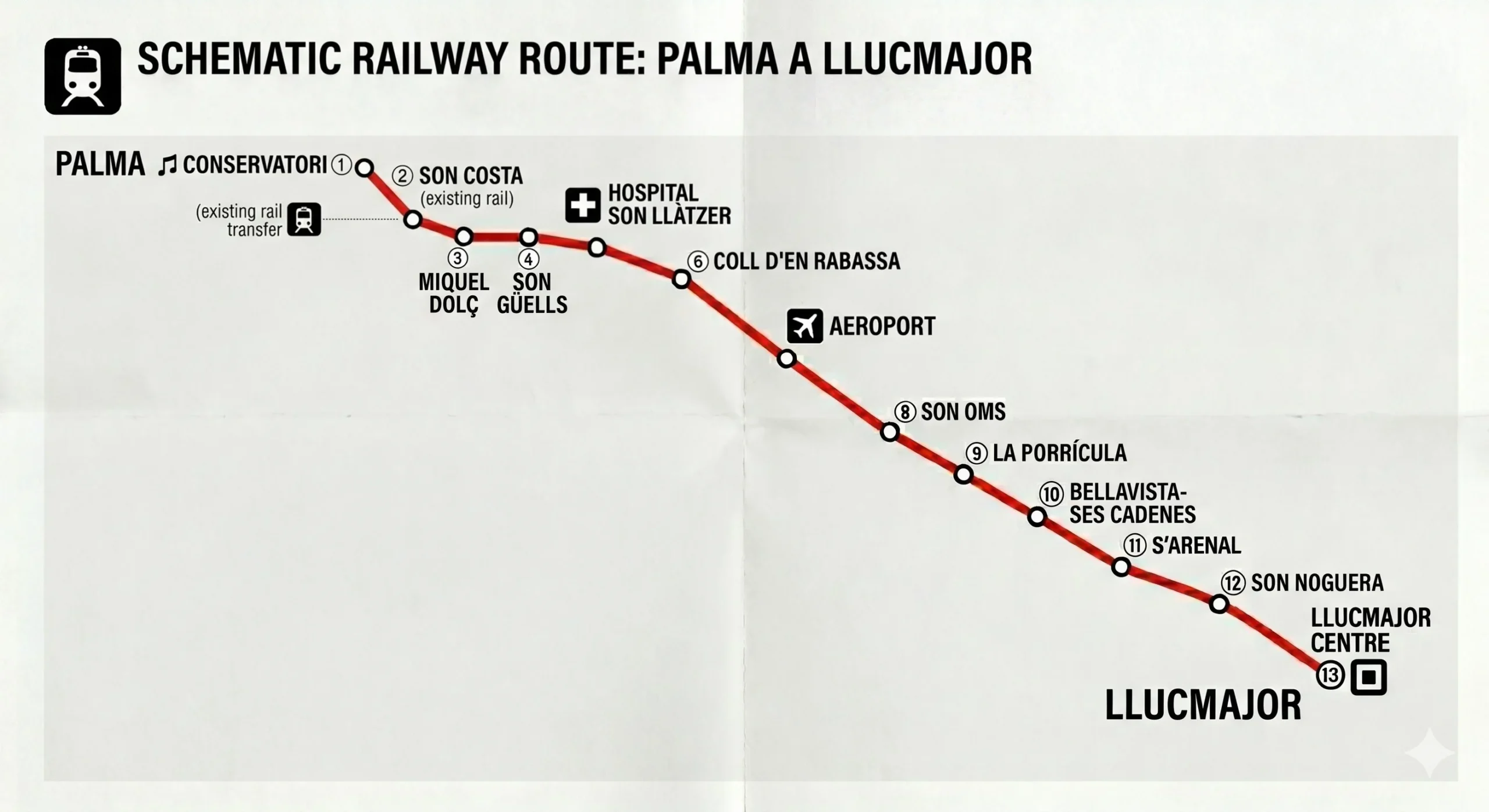
The new railway line will start in the centre of Palma and travel southeast toward Llucmajor. It will include the following stations:
Palma stations (10)
- Conservatori: The starting point near the Conservatory of Music.
- Son Costa: An existing hub providing a connection to the current rail network.
- Miquel Dolç: Located in the Pere Garau district.
- Son Güells: Serving the eastern residential areas.
- Hospital Son Llàtzer: A critical stop for the island’s major hospital.
- Coll d’en Rabassa: Near the commercial and residential coastal area.
- Aeroport: A major hub integrated into Son Sant Joan Airport.
- Son Oms: Serving the industrial and logistical park near the airport.
- La Porrícula: Near the s’Arenal/Platja de Palma area.
- Bellavista-Ses Cadenes: The final stop within the Palma municipal boundary.
Llucmajor stations (3)
- S’Arenal: Serving the Llucmajor side of the popular coastal resort.
- Son Noguera: Serving the industrial estate outside the main town.
- Llucmajor Centre: The terminal station is located in the heart of the town.
Schematic illustration of the proposed route
Heavy Rail, Not Metro
A common point of confusion regarding the expansion is whether it will be integrated into the Palma Metro. To clarify, this project is a core component of the SFM (Serveis Ferroviaris de Mallorca) rail network, which operates both the island’s regional trains and the Palma Metro lines.
While the Metro, including the existing M1 and the recently announced M2 line, serves as an urban transit system within Palma, the new Llucmajor line is a distinct, 30-kilometre heavy rail corridor. It is designed to provide a high-speed, long-distance connection between Palma, the airport, and Llucmajor, extending the SFM network into the island’s southeast corridor.
Evolution of the Airport Rail Project
The concept of a rail link to Palma de Mallorca Airport has been discussed in Balearic politics for over 30 years, though the current proposal differs significantly from previous plans.
- Historical Proposals: In the late 1990s and early 2000s, the focus was largely on a “tram-train” or light rail system. Known as the Trambadia, this would have operated at street level along the coast.
- The Current Plan: The 2026-ratified project abandons the coastal tram concept in favour of a faster, subterranean route. By utilising tunnel-boring machines for 10 kilometres of the journey, the new rail line bypasses surface congestion entirely.
Strategic Infrastructure Alignment
The Department of Infrastructure is currently modifying the plans for the first phase of the Second Ring Road (Segundo Cinturón), a new bypass designed to reduce traffic congestion around Palma, to ensure compatibility with the new rail line.
Because the two projects intersect near Coll d’en Rabassa, engineers have designed a 15-metre-wide underpass to be built beneath the future motorway. This preparatory work, scheduled for late 2026, ensures that the rail line can be constructed later without requiring expensive or disruptive road closures.
Furthermore, the planned station at Coll d’en Rabassa has been relocated to a green space adjacent to the airport motorway exit. This adjustment is designed to improve passenger access: it will include a new “Park and Ride” facility and provide a seamless interchange between the rail line and the local EMT bus network.
Opposition and Political Feasibility
As has been the case with all the railway expansion plans in Mallorca, the project has faced notable opposition, particularly regarding the intended second phase.
- The Campos Extension: Originally, the line was planned to continue to Campos. However, fierce protests from the DECA Platform (Defensa del Ciudadano ante Abusos) and local agricultural groups led the government to shelve this extension. Concerns were raised regarding the fragmentation of farmland and the environmental impact on rural estates.
- Urban Concerns: Within Palma, residents in the Pere Garau neighbourhood successfully lobbied for the inclusion of a stop at Miquel Dolç to ensure the project benefitted the local community rather than simply passing beneath it.
The Palma-Llucmajor section is now in the technical drafting phase with secured regional funding. While future political shifts or funding disputes with the central government could impact the timeline, the project has cleared its most significant administrative hurdles.
Project Timeline
- 2026: Commencement of preparatory roadworks and technical project finalisation.
- 2028: Scheduled start of rail construction.
- 2032: Estimated completion and inauguration of the line.
Once operational, this railway is expected to increase the island’s total passenger volume by 73%. Beyond the flagship benefit of providing a seamless, high-frequency rail link to Palma Airport, the project represents a significant strategic commitment to modernising Mallorca’s public transport infrastructure. By creating a sustainable, high-capacity alternative to private vehicle use, the new line will play a critical role in alleviating road congestion around the capital and significantly reducing the region’s carbon footprint.
